
Steve's Corner

This is a special time of year, as the weather starts to change, and hopefully so do we, for the better. It’s time for a Cheshbon HaNefesh, a spiritual accounting of our actions during the past year with the goal of improvement. It’s time for renewal and forgiveness. And it’s time for zachor, remembering.
When Yom Kippur comes around each year, I think about my Dad. Some of you know my chevra kadisha origin story. Dad died in 2004. The funeral director asked if I wanted to be a shomer the night before the burial. I had no idea about the ritual but after a brief explanation, decided to give it a try. It was transformational for me. I had hours of quiet time with Dad and was able to review our relationship, what he taught me, what life without him would bring. I spoke with him. I expressed my love and appreciation. I said goodbye.
Each year at the Yom Kippur Yizkor (memorial) service I think about that experience of connection. Dad was a man of few words, so shmirah might have been more powerful than our connection while he was alive. I’ve recently learned of another way to connect with our dead loved ones. It seemed a bit odd at first, but upon further reflection, I see its potential for good.
Here are excerpts of a story by Sydney Page about “Wind Phones.” The nearest ones to us in LA seem to be in South Pas and Duarte.
June 26, 2025, by Sydney Page
Colin Campbell was driving with his wife, Gail Lerner, and their two teens along Highway 62 near Morongo Valley, California, when a drunk driver going 90 miles an hour struck their car.
Ruby, 17, and Hart, 14, who were seated in the back, were killed in the crash. The family was on their way to their new home in the town of Joshua Tree that evening in June 2019.
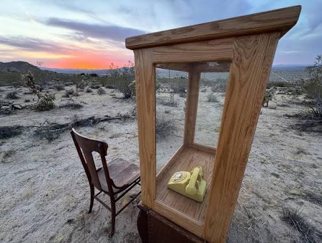
On June 12, the six-year anniversary of the crash, Campbell and Lerner installed a disconnected rotary phone as a wind phone, where mourners can make one-way calls to people they have lost. They placed it in Joshua Tree — one of Ruby and Hart’s favorite places.
“The last thing we did as a family was pick that house,” Campbell said. “It became a grief sanctuary.”
They hoped the wind phone, placed near their home, would offer them and others a quiet space to connect with lost loved ones and move through grief.
“Anyone in grief can visit, sit down in the privacy of the vast desert, pick up the rotary phone and call their loved one via the cosmic connection,” Campbell explained.
The concept of a wind phone began in Japan in 2010. After losing his cousin to cancer, a man named Itaru Sasaki put an old-fashioned phone booth in his garden to feel a continued connection.
A year later, following a devastating earthquake and tsunami that killed thousands, Sasaki moved his phone booth to a hill overlooking the Pacific Ocean.
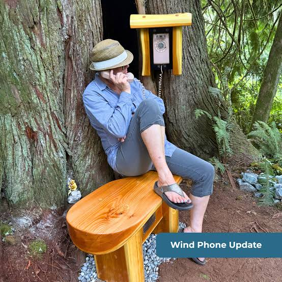
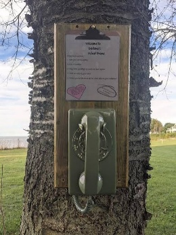
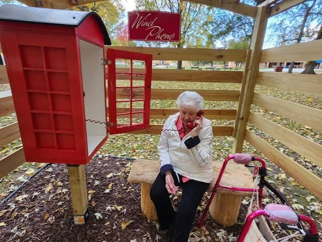
Since then, hundreds of wind phones have appeared around the world, including nearly 300 in the United States. Typically located in secluded outdoor spaces, they feature disconnected rotary phones available for public use.
“I was really excited to make one,” Lerner said. “There is a rabbi named Abraham Joshua Heschel who said, ‘build your life as if it were a work of art’ and this seemed like a wonderful way to do that.”
Lerner made the first call. She created a phone number combining Ruby’s and Hart’s birthdays. Then she began speaking to her children.
“I felt this rush, this deep connection,” Lerner said. “Usually when I talk to Ruby and Hart, I’m crying, shouting, asking where they are. But this time it felt different.”
“I was just telling them, ‘Hey, we miss you. Here’s what Dad and I are doing, here’s what we made for you,’” Lerner continued. “It wasn’t like I felt them responding, but I felt like they were hearing it, and I felt like my words were reaching them.”
People have already started visiting the wind phone, including Colleen Leonard, who came on June 22, after hearing about it on social media.
“I was really struggling, grieving lots of different people,” said Leonard, who lives in Twentynine Palms, California. “All sorts of people have been heavy on my heart.”
She called her friend’s daughter, Katie, who died in 2023 at age 15. She also called her cousin, Nick, who died at 19 in 2002.
“I just kept going,” Leonard said. “I definitely left there feeling less heavy … It was a little bit of joy, and I think sometimes, those little bits of joy carry you through grief.”
Campbell and Lerner said that’s exactly how they hoped the phone would make people feel. If grief is love with nowhere to go, the phone can be a place for those feelings to land, even momentarily.